How Progressive Overload Helps Build Muscle Faster

If you’ve been lifting weights for weeks or even months without seeing significant muscle growth, the problem may not be your workout routine—it could be that you’re missing one of the most important principles of strength training: progressive overload.
Progressive overload is the foundation of building muscle, increasing strength, and improving overall fitness. Whether you’re a beginner stepping into the gym for the first time or an experienced lifter trying to break through a plateau, understanding how progressive overload works can completely transform your results.
Many people repeat the same exercises with the same weights every week and wonder why their bodies stop changing. The truth is that muscles only grow when they are challenged beyond what they are already accustomed to. Progressive overload provides that challenge in a safe, structured, and effective way.
In this complete guide, you’ll learn how progressive overload helps build muscle faster, why it works, the best methods to apply it, common mistakes to avoid, and how to create a workout routine that delivers long-term results.
What Is Progressive Overload?
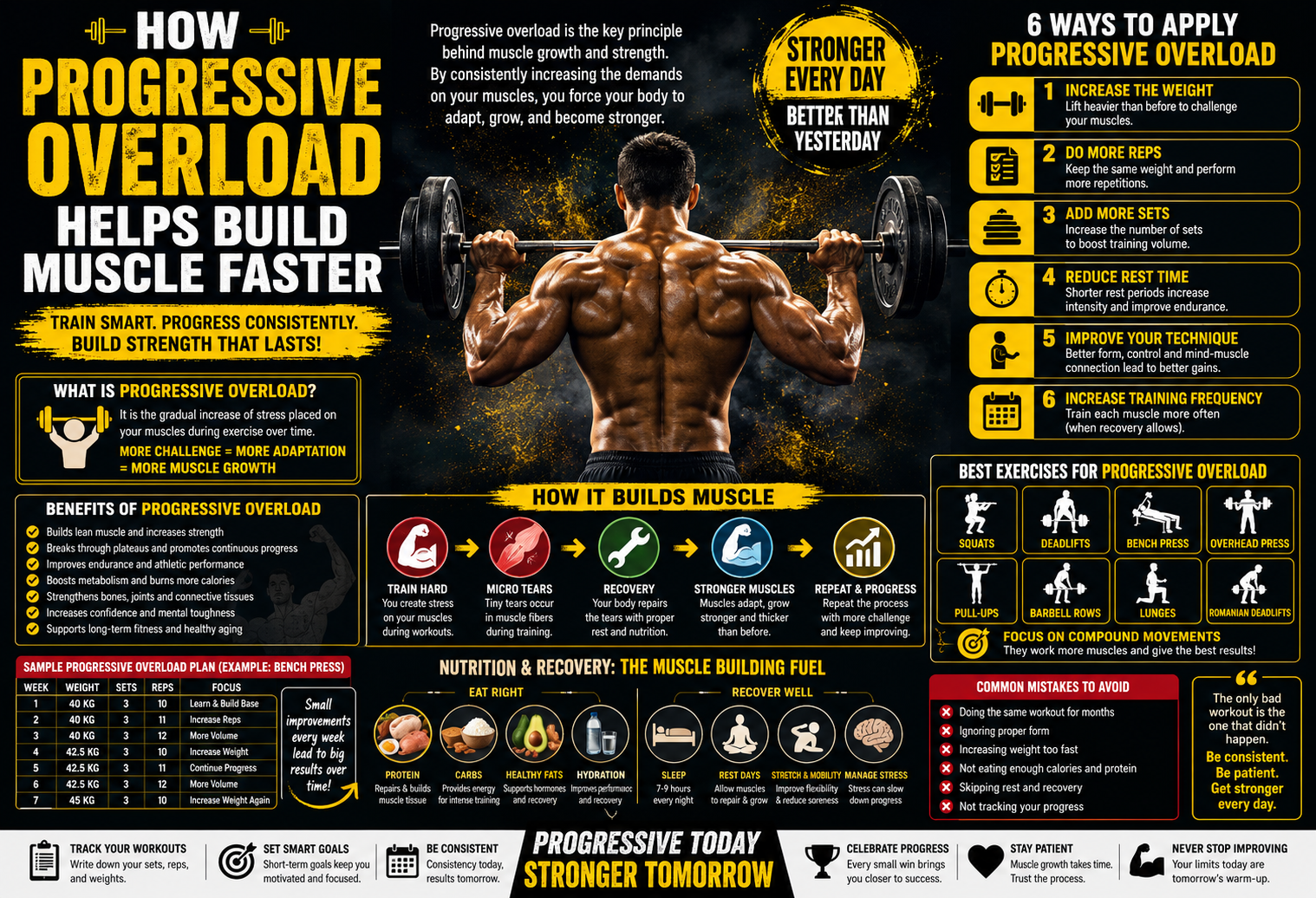
Progressive overload is the process of gradually increasing the demands placed on your muscles during exercise. As your muscles adapt to a certain level of resistance, you must continue challenging them by increasing the intensity of your workouts.
This gradual increase stimulates muscle fibers, encouraging them to repair, grow stronger, and become larger over time.
Without progressive overload, your body adapts to your current workout, and muscle growth slows down or stops altogether.
Simply put:
More challenge = More adaptation = More muscle growth.
Why Progressive Overload Is Essential for Muscle Growth
Every time you perform resistance exercises, tiny microscopic tears develop in your muscle fibers. During recovery, your body repairs these fibers, making them stronger and thicker than before.
If your workouts remain unchanged for months, your muscles no longer receive enough stimulus to continue adapting.
Progressive overload keeps your muscles responding by introducing new challenges.
This process helps improve:
- Muscle size (Hypertrophy)
- Overall strength
- Muscular endurance
- Bone density
- Athletic performance
- Metabolism
- Functional fitness
It is one of the most scientifically proven principles in strength training.
The Science Behind Progressive Overload
Muscles constantly adapt to stress.
When you lift weights that are slightly heavier than before or perform additional repetitions, your nervous system and muscle fibers work harder to complete the movement.
Your body responds by:
- Recruiting more muscle fibers
- Increasing protein synthesis
- Improving neuromuscular coordination
- Strengthening connective tissues
- Enhancing muscular efficiency
Over weeks and months, these small improvements lead to significant increases in muscle size and strength.
Different Ways to Apply Progressive Overload
Many people believe progressive overload only means lifting heavier weights.
In reality, there are several effective methods.
1. Increase the Weight
This is the most common approach.
Example:
Week 1: Bench Press – 40 kg
Week 2: Bench Press – 42.5 kg
Week 3: Bench Press – 45 kg
Even small increases create new challenges.
2. Perform More Repetitions
If increasing weight isn’t possible, perform additional repetitions.
Example:
Week 1: 10 reps
Week 2: 11 reps
Week 3: 12 reps
After reaching your target repetitions, increase the weight.
3. Add More Sets
Increasing training volume is another effective method.
Example:
3 sets become 4 sets.
More total work equals greater muscle stimulation.
4. Improve Exercise Technique
Better movement quality allows muscles to work more effectively.
Controlled repetitions often stimulate more muscle growth than simply lifting heavier weights with poor form.
5. Reduce Rest Time
Gradually shortening rest periods increases workout intensity and muscular endurance.
Example:
90 seconds becomes 75 seconds.
Then 60 seconds.
6. Increase Training Frequency
Instead of training each muscle once weekly, many people benefit from training it twice weekly.
More frequent stimulation often leads to faster progress.
Best Exercises for Progressive Overload
Compound exercises respond especially well because they involve multiple muscle groups.
Examples include:
- Squats
- Deadlifts
- Bench Press
- Overhead Press
- Pull-Ups
- Barbell Rows
- Lunges
- Romanian Deadlifts
Isolation exercises can also be progressively overloaded.
Examples:
- Bicep Curls
- Triceps Extensions
- Lateral Raises
- Leg Extensions
- Hamstring Curls
- Calf Raises
Progressive Overload for Beginners
Beginners usually experience rapid progress because their bodies adapt quickly.
Simple guidelines:
- Learn correct technique first.
- Focus on compound movements.
- Increase weight slowly.
- Keep a workout journal.
- Prioritize recovery.
Avoid rushing.
Small weekly improvements produce impressive long-term results.
Progressive Overload for Intermediate Lifters
Intermediate athletes often encounter plateaus.
To continue progressing:
- Track every workout.
- Rotate rep ranges.
- Periodize training.
- Add accessory exercises.
- Monitor recovery.
- Improve nutrition.
Consistency becomes more important than dramatic increases.
Nutrition Supports Progressive Overload
Muscles cannot grow without proper nutrition.
Your diet should include:
High-Quality Protein
Protein repairs muscle tissue.
Good sources:
- Eggs
- Chicken
- Fish
- Lean meat
- Greek yogurt
- Cottage cheese
- Lentils
- Soy products
Healthy Carbohydrates
Carbohydrates fuel workouts.
Examples:
- Oats
- Rice
- Sweet potatoes
- Fruits
- Whole grains
Healthy Fats
Healthy fats support hormone production.
Include:
- Nuts
- Seeds
- Olive oil
- Avocados
Hydration
Muscles function better when properly hydrated.
Drink sufficient water before, during, and after training.
Recovery Is Part of Progressive Overload
Muscles grow while resting—not while training.
Recovery includes:
- 7–9 hours of sleep
- Rest days
- Stretching
- Mobility exercises
- Stress management
- Proper nutrition
Ignoring recovery often leads to poor performance and injury.
Common Mistakes to Avoid
Many gym-goers unknowingly slow their progress.
Avoid these mistakes:
Lifting Too Heavy
Poor technique increases injury risk.
Focus on controlled movement.
Increasing Weight Too Quickly
Progress should be gradual.
Large jumps reduce exercise quality.
Skipping Warm-Ups
Warm muscles perform better and reduce injury risk.
Poor Nutrition
Without enough calories and protein, muscles cannot recover properly.
Not Tracking Progress
A workout log helps identify improvements.
Track:
- Weight
- Sets
- Repetitions
- Rest periods
Overtraining
More isn’t always better.
Recovery is equally important.
Sample Progressive Overload Strategy
Week 1
Bench Press
40 kg
3 × 10
Week 2
40 kg
3 × 11
Week 3
40 kg
3 × 12
Week 4
42.5 kg
3 × 10
Repeat the cycle.
This gradual approach allows consistent improvement.
Benefits Beyond Muscle Growth
Progressive overload improves much more than appearance.
Benefits include:
- Greater functional strength
- Improved athletic performance
- Better posture
- Increased confidence
- Stronger bones
- Higher calorie burn
- Improved metabolism
- Reduced injury risk
- Better mobility
- Long-term fitness
Tips for Long-Term Success
Stay consistent.
Focus on quality over quantity.
Be patient.
Eat nutritious foods.
Sleep adequately.
Train with proper form.
Celebrate small improvements.
Remember that muscle growth takes time.
Final Thoughts
Understanding how progressive overload helps build muscle faster is one of the most valuable lessons anyone can learn in fitness. Rather than chasing quick fixes or constantly changing workout programs, focus on gradually increasing the demands placed on your muscles.
Whether it’s adding a little more weight, performing one extra repetition, completing an additional set, or improving your exercise technique, every small improvement contributes to greater strength and muscle development over time.
Combined with proper nutrition, quality sleep, and consistent training, progressive overload provides a proven path toward building a stronger, healthier, and more muscular body. Stay disciplined, monitor your progress, and trust the process. The results will come through steady effort and smart training.
Frequently Asked Questions (FAQs)
What is progressive overload?
Progressive overload is the gradual increase of training intensity to continuously challenge muscles, leading to strength and muscle growth.
How often should I increase weight?
Increase the weight only when you can complete all sets and repetitions with proper form. Small increases every one to three weeks are common.
Can beginners use progressive overload?
Yes. Beginners often experience the fastest improvements by gradually increasing resistance while learning proper technique.
Does progressive overload work without weights?
Yes. You can increase repetitions, improve exercise difficulty, reduce rest time, or use resistance bands and bodyweight exercises.
How long does it take to build muscle?
Visible muscle growth depends on training consistency, nutrition, recovery, and genetics. Most people begin noticing measurable improvements within 8–12 weeks of structured progressive overload training.